The history of motherhood within Tejano culture in South Texas is deeply connected to the earliest foundations of Hispanic society in the region. One can reasonably argue that many of the family traditions still present today began with the settlers of Nuevo Santander during the eighteenth century. These Spanish colonial families moved northward into what is now South Texas and Northern Mexico, bringing with them a blend of Iberian Spanish customs, Catholic spirituality, and frontier endurance that would gradually evolve into the Tejano culture recognized today.
Life on the northern frontier of New Spain was harsh and uncertain. Ranches, missions, villages, and presidios were separated by vast distances of brush country, rivers, drought, and conflict. In these difficult conditions, the family became the center of survival. Mothers, grandmothers, aunts, and extended kin networks played critical roles in preserving stability, faith, language, and cultural identity.
Modern social science studies examining Hispanic and Mexican American motherhood in Texas continue to observe these same characteristics today: strong family cohesion, multigenerational childrearing, maternal sacrifice, emotional warmth, and the prioritization of children above self-interest.
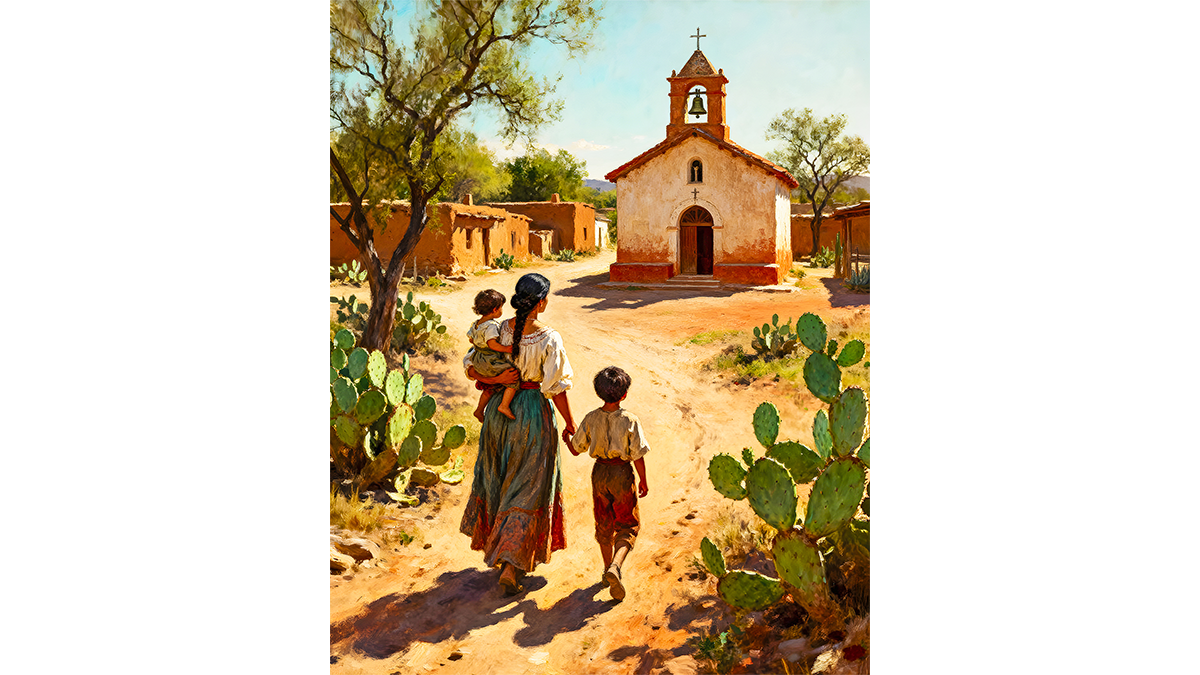
This artwork portrays a Mexican mother and child within a traditional village setting, emphasizing tenderness, protection, and the emotional closeness so central to Hispanic family life. Warm earth tones and painterly realism reflect both the intimacy of motherhood and the enduring cultural traditions of rural Mexican and Tejano communities.
The descendants of those early Nuevo Santander colonists remain proud Americans while still maintaining many cultural traditions rooted in centuries of family life along the Rio Grande frontier. In many Tejano households, motherhood has traditionally been understood as a shared responsibility. Grandmothers often help raise children alongside the birth mother. Aunts, godmothers, cousins, and even trusted lifelong family friends frequently become part of the emotional and practical support structure surrounding children.
Social scientists studying Mexican American family systems have repeatedly documented the importance of this extended kinship model, describing it as one of the defining strengths of Hispanic family culture in Texas and the American Southwest.
At the center of this maternal ideal has long stood the image of the Virgin Mary. Since the sixteenth-century apparition of Our Lady of Guadalupe in Mexico, devotion to the Virgin Mother has occupied a central place in Mexican and Tejano spirituality. Yet this spiritual tradition was not shaped solely by Spanish Catholicism. It also absorbed powerful elements of older Mesoamerican understandings of motherhood, nature, spirituality, and sacred life.
Long before Spanish arrival, Mesoamerican civilizations viewed the natural world as deeply spiritual. The earth, water, plants, seasons, fertility, and motherhood itself were often understood as sacred realities connected to divine order. Mothers were not only caretakers of children, but protectors of continuity between family, land, ancestors, and community.
When Catholicism entered Mexico, many of these older spiritual understandings merged with Christian belief rather than disappearing completely. The Virgin Mary, particularly in her form as Our Lady of Guadalupe, became intertwined with older concepts of sacred motherhood, compassion, protection, and closeness to ordinary people.
This blending of Spanish Catholic and Mesoamerican spirituality helped create a distinctive religious culture in which faith became deeply woven into family life and childrearing.
Inspired by the dramatic lighting and emotional warmth of Baroque devotional art, this Madonna and Child image reflects the spiritual ideal of motherhood that has profoundly influenced Hispanic family culture for centuries. The artwork symbolizes sacrifice, compassion, protection, and maternal devotion rooted in both Catholic and Hispanic traditions.
Religious formation of children became one of the central duties of motherhood. Teaching prayers, respect for sacred traditions, church observances, reverence toward elders, and moral responsibility became part of daily family life. In many Tejano households, mothers and grandmothers traditionally served as the first religious teachers of children. Faith was often transmitted not only through church attendance, but through stories, devotional images, candles, feast days, family altars, meals, and customs tied to the rhythms of life and nature.
Modern social science research continues to confirm how important religion and spirituality remain within many Hispanic family systems. Researchers frequently find that Mexican American mothers see spiritual formation as inseparable from raising emotionally grounded and morally responsible children.
One of the most fascinating historical connections to this culture is found in General Ignacio Zaragoza, the celebrated defender of Mexico at the Battle of Puebla on Cinco de Mayo. Zaragoza himself was born in Goliad, Texas, before his family later moved into Mexico. Though remembered as a Mexican national hero, he was also a son of the Texas frontier and a product of the same Tejano cultural world shaped by Nuevo Santander traditions.
The values social scientists identify today—family loyalty, sacrifice, perseverance, spirituality, and communal responsibility—were already deeply rooted in Tejano households generations before Zaragoza’s birth.
This nostalgic kitchen scene honors the role of grandmothers within Hispanic family life. In many Tejano households, recipes, prayers, stories, and cultural values are passed from generation to generation around the family table. The artwork celebrates the warmth, continuity, and multigenerational bonds long associated with Mexican American motherhood.
The victory at Puebla became more than a military triumph. It represented the defense of a culture that had been evolving for centuries from the blending of Spanish and Mesoamerican civilization. Without those communities preserving their language, religion, traditions, and family structures, the unique culture we now identify as Tejano or Mexican American might never have fully emerged in the form we recognize today.
For me as an artist, the Tejano mother and the Virgin Mother remain enduringly compelling subjects. They embody themes that transcend history alone: devotion, endurance, protection, sacrifice, and cultural continuity. In South Texas especially, one can still see how motherhood remains at the center of family identity.
The grandmother teaching prayers to children, the mother preserving recipes and traditions, the extended family gathering together across generations—these are living continuations of a cultural inheritance stretching back to the colonial settlements of Nuevo Santander.
This village scene portrays a Mexican mother walking her children toward a small church within a traditional village setting, symbolizing the central role mothers have historically played in the spiritual formation of children within Tejano and Mexican culture. The composition reflects themes of protection, faith, family unity, and cultural continuity while using warm Southwestern earth tones suited for Spanish Colonial, rustic, and contemporary Southwestern home interiors.
Art centered on Tejano motherhood therefore becomes more than portraiture or historical representation. It becomes a reflection of cultural memory itself. Whether expressed through religious imagery inspired by the Virgin Mary or through scenes of everyday maternal life in South Texas families, these works honor the women whose devotion helped preserve and shape an entire people across centuries of frontier life, hardship, faith, and perseverance.
Leave a Reply