Cinco de Mayo is often misunderstood as a general celebration of Mexican independence, but its true significance runs far deeper. It commemorates the Battle of Puebla in 1862—a moment when the Mexican people, against overwhelming odds, defeated a powerful European army. This was not just a military victory. It was a defining moment that helped preserve something far greater: the continuation and evolution of a unique cultural identity.
The culture we know today as Hispanic, Latino, or Mexican American did not emerge by accident. It is the result of centuries of blending—European Spanish traditions merging with the rich civilizations of Mesoamerica. By the mid-19th century, this identity was still forming, still fragile, and still under threat. Had Mexico fallen decisively to foreign control at Puebla, the development of this culture might have been delayed, altered, or even suppressed.
A Turning Point Beyond the Battlefield
The Battle of Puebla demonstrated that the Mexican nation—composed of criollos, mestizos, and indigenous peoples—could unite, organize, and defend its sovereignty. This unity was essential not just politically, but culturally.
What followed in the decades after Puebla was the strengthening of a shared identity:
- A language enriched by indigenous and Spanish influences
- Culinary traditions blending Old World and New World ingredients
- Artistic expressions rooted in both European techniques and native symbolism
- Spiritual traditions combining Catholic devotion with older cultural memory
Most importantly, it reinforced a mindset—perseverance, resilience, and determination—that continues to define Mexican and Mexican American communities today.
The Cultural Legacy We See Today
When we celebrate Cinco de Mayo, we are not just remembering a battle. We are recognizing the survival and flourishing of a culture.
The music of the Rio Grande Valley, the food traditions passed through generations, the literature that captures both struggle and beauty, and even the visual language of art—all of these are part of a cultural continuum that Puebla helped protect.
Without that victory, the trajectory of this cultural evolution might have been profoundly different.
The Artwork: Capturing the Spirit of Puebla
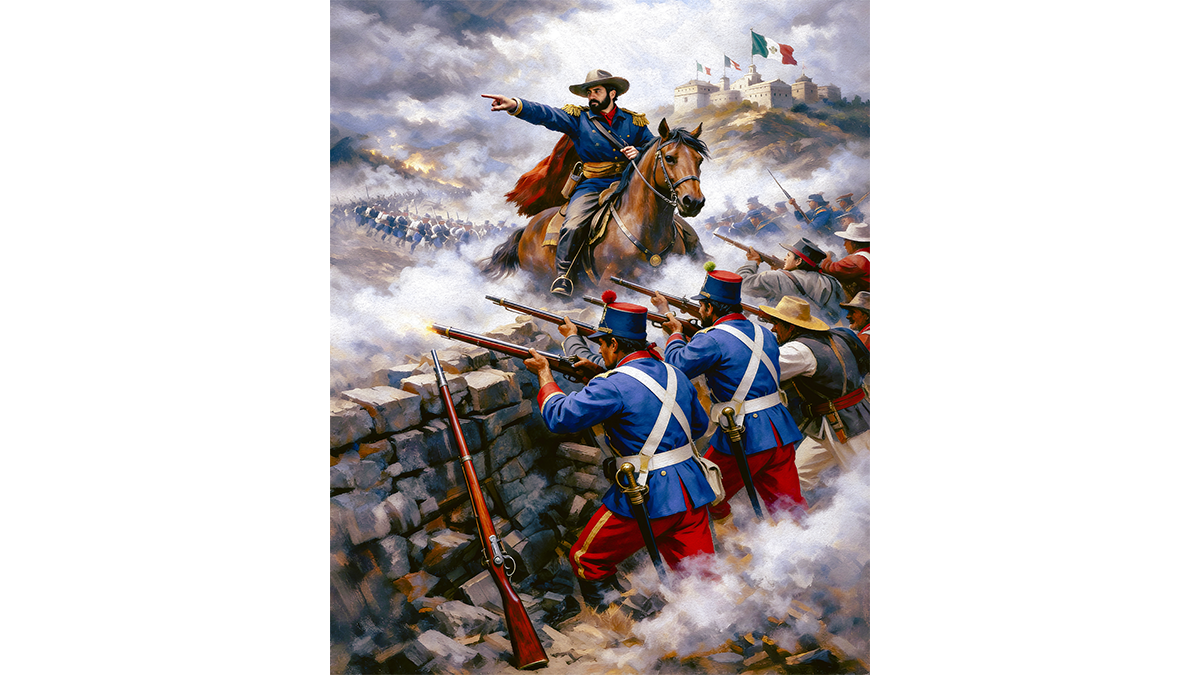
The featured artwork, “Cinco de Mayo Puebla Battle Print – Zaragoza Historical Mexican War Hero Wall Art Decor,” brings this pivotal moment vividly to life.
The scene is filled with motion and urgency:
- Mexican soldiers in blue and red uniforms brace behind a stone wall, firing muskets into advancing forces
- Smoke rolls across the battlefield, creating a dramatic chiaroscuro effect that heightens tension
- In the center, a commanding figure—General Ignacio Zaragoza—rides forward, arm extended, directing his troops with resolve and clarity
- Above, the Mexican flag waves over fortified ground, symbolizing both resistance and national identity
The composition draws from historical realism with painterly execution, blending accuracy with emotional storytelling. The use of dynamic diagonals, layered depth, and atmospheric haze places the viewer directly into the moment—one of courage under pressure.
This is not just a depiction of war. It is a visual narrative of leadership, unity, and defiance.
Why This Moment Still Matters
The legacy of Puebla is not confined to history books. It lives on in communities across Mexico and the United States—in traditions, values, and daily life.
Cinco de Mayo reminds us that cultural identity is not guaranteed. It must be protected, preserved, and carried forward.
The perseverance seen on that battlefield continues today:
- In families maintaining traditions across generations
- In artists expressing cultural memory through modern forms
- In communities that honor both heritage and progress
A Celebration of Endurance and Identity
This artwork serves as both a historical tribute and a cultural symbol. It speaks to collectors, history enthusiasts, and anyone who values the deeper meaning behind Cinco de Mayo.
Displayed in a home, office, or cultural space, it becomes more than decoration—it becomes a statement of heritage, resilience, and identity.
Leave a Reply