Cinco de Mayo is often misunderstood outside Mexico. It is not Mexican Independence Day, nor was it the Mexican Revolution itself. Instead, Cinco de Mayo commemorates Mexico’s unexpected victory over the French army at the Battle of Puebla on May 5, 1862—a defining milestone that helped shape modern Mexican identity.
In many ways, the battle served as a prelude to the spirit that would later animate Mexico’s revolutionary movements. It demonstrated that the new Mexican nation—formed through centuries of blending Spanish colonial society with ancient Mesoamerican peoples—could unite, organize, and defeat one of Europe’s most respected military powers.
How the French Occupation Happened
After years of political instability and economic hardship, Mexico suspended payments on foreign debts. France, under Emperor Napoleon III, used the opportunity to intervene militarily and sought to establish influence in Mexico. French forces landed and advanced inland, expecting a quick victory.
Instead, they encountered determined resistance from the Mexican Republic.
Who Was General Ignacio Zaragoza?
Ignacio Zaragoza was the young and capable commander who led Mexico’s Army of the East. Calm, disciplined, and patriotic, Zaragoza understood the terrain around Puebla and prepared defenses around the forts of Loreto and Guadalupe. Though outmatched in equipment, he inspired confidence and unity among his troops.
After the battle, he famously reported: “The national arms have covered themselves with glory.”
The Soldiers of Mexico United
One of the most meaningful aspects of Puebla was the diversity of those who fought together. Mexican defenders included:
- Criollos – Mexicans of Spanish ancestry born in the Americas
- Mestizos – Citizens of mixed Spanish and Indigenous heritage
- Indios – Indigenous Mexican communities with deep ancestral roots
- Local militia, rancheros, laborers, and volunteers
Together they fought not as separate groups, but as Mexicans defending their country.
Weapons of the Battle
The battle was fought with mid-19th century arms:
- Percussion-cap muskets and rifled muskets
- Fixed bayonets
- Field artillery and cannons
- Cavalry sabers and pistols
- Stone fortifications and defensive barricades
French troops were well-trained and well-equipped, but Mexican defenders used terrain, courage, and determination to overcome the odds.
What Happened at Puebla
French forces attacked uphill toward the fortified heights outside Puebla, expecting to break the Mexican line. Instead, they faced fierce resistance, disciplined musket fire, artillery, and repeated repulses. Rain, mud, and difficult terrain further weakened the assault.
By day’s end, the French withdrew. It was a stunning moral and symbolic victory for Mexico.
About the Artwork: Turning Point at Puebla Battle Print
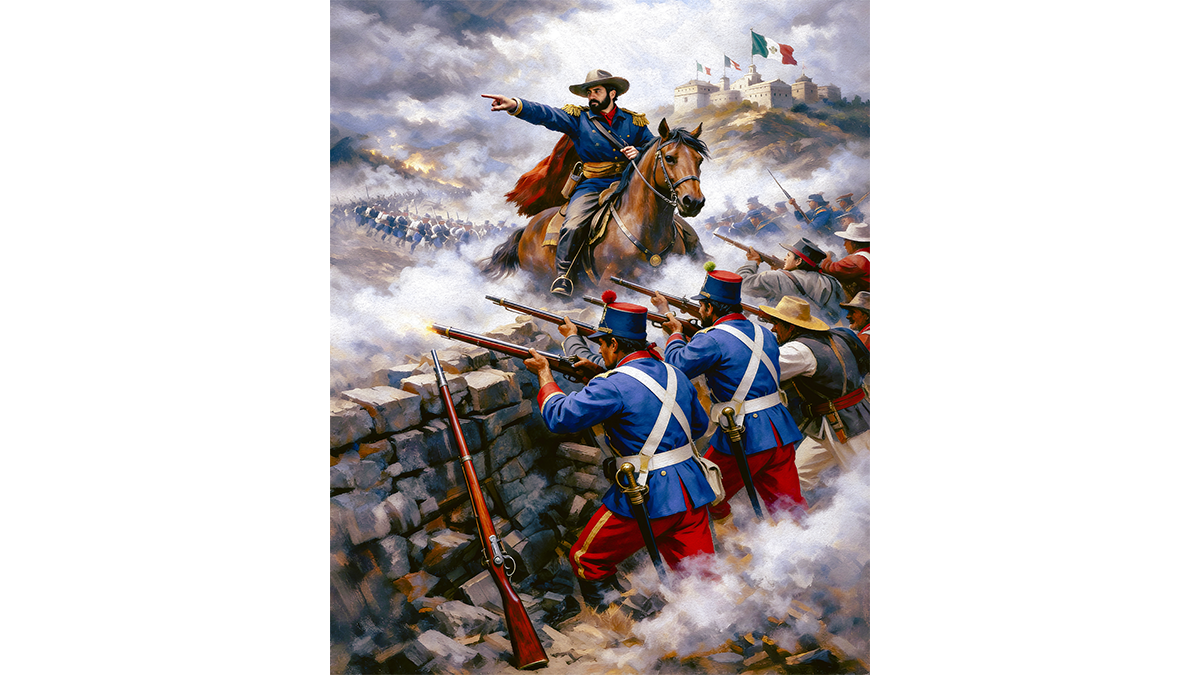
Turning Point at Puebla Battle Print Cinco de Mayo Zaragoza Historical Wall Art captures this heroic moment in vivid painterly realism.
The composition centers on General Zaragoza mounted on horseback, pointing forward through smoke and chaos. In the foreground, Mexican soldiers fire from stone barricades while volunteers stand firm beside them. In the background, French columns struggle uphill beneath storm clouds as the forts rise above the battlefield.
Light breaking through the sky symbolizes triumph, unity, and hope.
Who This Art Will Appeal To
This print is ideal for:
- Mexican history enthusiasts
- Hispanic heritage families
- Cinco de Mayo celebrations
- Military history collectors
- Teachers and classrooms
- Southwestern and Spanish Colonial interiors
- Office, library, and study décor
- Collectors of patriotic historical art
It is both a powerful decorative statement and a reminder of national resilience.
Leave a Reply