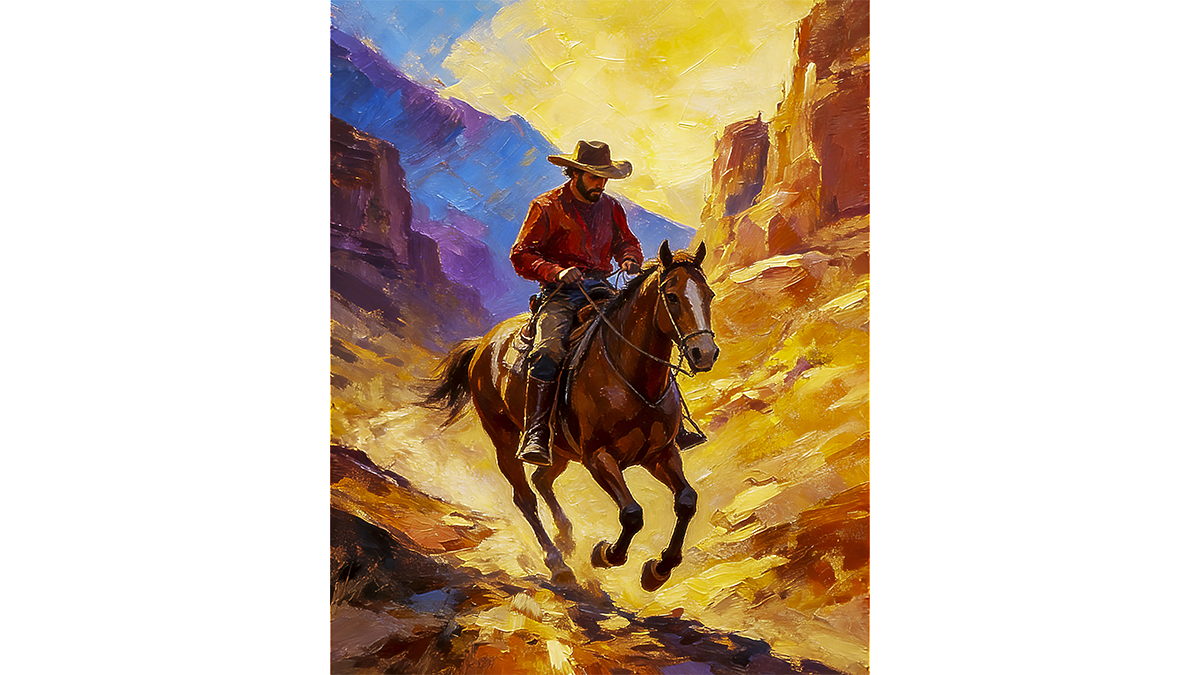
There is something timeless—almost sacred—about the solitary rider moving through the vast Southwest. Whether under a blazing canyon sun or riding into a quiet desert dusk, the cowboy represents more than a profession. He represents independence, resilience, and a deep connection to land that stretches back centuries.
My Cowboy Canyon Giclée Print captures that very moment—when a rider, alone with his horse, moves through a rugged canyon illuminated by golden light. It is not just a Western scene. It is a continuation of a cultural story that began long before the American West was ever imagined.
The True Origins: The Mexican Vaquero
The cowboy most people recognize today has roots that begin far south of Texas. The original cowboys were the Mexican vaqueros, whose traditions came from Spanish ranching practices introduced to the Americas in the 1500s.
The word vaquero itself comes from vaca—meaning cow—and these early horsemen were masters of cattle handling, horsemanship, and survival in harsh, dry landscapes.
By the 1700s, their skills had spread north into what is now Texas, New Mexico, and Arizona.
What’s often overlooked is this:
the cowboy did not originate in America—America inherited him.
Even the iconic tools and imagery we associate with cowboys—lassos, saddles, spurs, bandanas—were shaped by vaquero culture.
South Texas: Where Cultures Merged
In South Texas, where my own artistic perspective is rooted, the cowboy identity became something uniquely blended. Spanish, Mexican, Indigenous, and later Anglo traditions merged into what we now think of as the Western cowboy.
In fact, during the early cattle drive era, many of the working cowboys in Texas were Hispanic, carrying forward vaquero traditions directly.
This is important to understand when viewing artwork like:
These are not reinterpretations—they are closer to the original source.
The Solitary Rider: A Symbol Beyond Time
What has endured most powerfully is not just the work—but the image.
The lone rider.
Why does it resonate so strongly?
Because it reflects something deeply human:
- Independence
- Quiet endurance
- A relationship with nature rather than control over it
In Cowboy Canyon, the rider is not battling the land—he is moving through it, guided by instinct and experience. The canyon glows with heat and light, yet the figure remains calm, grounded, and focused.
This echoes the reality of vaqueros and early cowboys, who often worked alone across vast distances, relying only on their horse, their skill, and their judgment.
From Reality to Art: The Evolution of the Western Image
Over time, the cowboy became mythologized—through literature, film, and art. But beneath that myth remains a truth grounded in history.
My collection reflects that evolution which not only captures the emotional and essential essence and connects directly to historical origins but also interprets the legacy in modern artistic language.
From reality → to memory → to artistic interpretation
And that’s exactly how Western culture survives—not just through history books, but through visual storytelling.
Why This Still Matters Today
The continued appreciation of cowboy and vaquero imagery isn’t just nostalgia. It reflects a longing for:
- Simplicity in a complex world
- Connection to land and tradition
- Individual strength and self-reliance
In a time of rapid change, the cowboy remains a symbol of something steady and enduring.
That’s why these prints resonate so strongly with collectors today—especially those drawn to:
- Western heritage
- South Texas and Southwest culture
- Ranching history
- Earth-tone, rustic, or Spanish Colonial interiors
Final Reflection
When you look at Cowboy Canyon, you are not just seeing a rider in a landscape.
You are seeing the continuation of a legacy that began with the vaquero—
refined in South Texas—
and carried forward into modern Western identity.
A man, a horse, and the open land.
That image has never lost its power.
Leave a Reply