I did not grow up thinking about vaqueros in history books. I met their world at night, under a South Texas sky, holding a kerosene lantern and a deer rifle.
As a teenager working on a Beefmaster breeding ranch in South Texas, we had no enclosed calving barns. When a cow was close to delivering, we stayed with her through the night. The lantern cast long shadows across the grass. Coyotes were never far. The rifle wasn’t there for drama—it was there because loss was real. A single calf mattered.
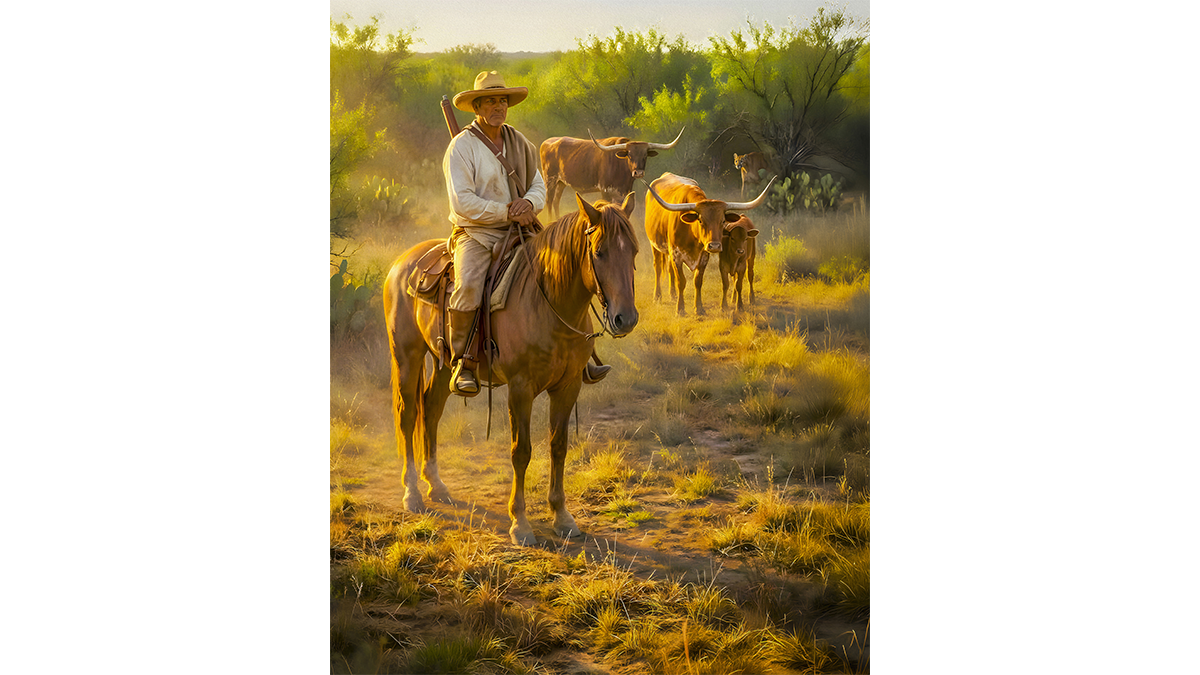
That experience stayed with me. Decades later, it became the emotional seed for Vaquero Guarding Longhorn Cattle, a fine art print set in 19th-century Nuevo Santander, when the risks were greater, the nights longer, and help far away.
Predators and Thieves on the Northern Frontier
Today, the Rio Grande Valley has almost no wolves and only rare cougar sightings. Dense brush has been cleared. Ranches are fenced. Roads are everywhere.
That was not the reality of South Texas in the 18th and 19th centuries.
Nuevo Santander—stretching across what is now South Texas and northeastern Mexico—was an open frontier. Vaqueros did not simply ride cattle; they guarded them. Predators included coyotes, wolves, cougars, and occasionally jaguars pushing north from Mexico. Cattle theft was also a constant threat, especially in isolated grazing lands.
Livestock represented survival, wealth, and continuity. Losing a calf meant more than inconvenience—it meant hardship.
The vaquero in this artwork sits in calm vigilance, not action. That is deliberate. True ranch work is mostly waiting, listening, watching the brush.
Firearms Were Rare—Skill Was Not
In the artwork, the vaquero carries a short-barrel musket slung across his torso. This detail is historically grounded but intentionally restrained.
Firearms in early 19th-century Nuevo Santander were scarce and expensive. Many guns were imported from Europe—Spain, France, or northern Italy—often older flintlock muskets rather than modern rifles. Ammunition was limited, powder precious.
Many vaqueros never carried firearms at all.
Those with experience in the Spanish colonial militia might carry a long lance instead—an effective weapon against predators and thieves alike, and far more common than guns. The lance, rope, knife, and horse were often more reliable tools than a musket that might misfire in dust or humidity.
The artwork reflects this reality: the gun is present, but not dominant. The true power lies in awareness, posture, and readiness.
Spanish Longhorns: Tough Cattle for a Harsh Land
The cattle depicted are Spanish longhorns—the ancestors of the Texas Longhorn.
Historically, these cattle were brought from Spain, with roots in hardy Andalusian and Iberian stock. They were not bred for tenderness or bulk. They were bred to survive.
Spanish longhorn cattle tolerated heat, drought, poor forage, predators, and long drives. They calved easily, defended their young aggressively, and thrived where European cattle failed. That toughness made them ideal for Nuevo Santander’s harsh environment.
Over time, however, ranching priorities changed.
As fencing, railroads, feed, and veterinary care improved, ranchers began importing and crossbreeding cattle from Europe and later Asia—breeds that produced more meat, more fat, and faster growth. Longhorns were gradually replaced by cattle better suited to commercial markets, though often less suited to raw survival.
The cattle in this artwork belong to an earlier logic of ranching—one built on endurance rather than efficiency.
Why This Scene Matters
This piece is not nostalgia. It is memory layered with history.
The cougar in the background is not obvious at first glance. That, too, is intentional. Predators rarely announce themselves. Danger is usually quiet.
The golden light softens the scene, but the tension remains. A calf stands close to its mother. The vaquero watches the brush. Nothing dramatic happens—and that is exactly how real protection looks.
When I think back to those nights on the ranch, lantern light flickering and coyotes calling from beyond the pasture, I understand something the vaqueros of Nuevo Santander knew well: guarding livestock is an act of patience, responsibility, and quiet courage.
This artwork is my way of honoring that continuity—from Spanish frontier vaqueros to modern ranch hands—bound by the same land, the same animals, and the same watchful nights.
Leave a Reply